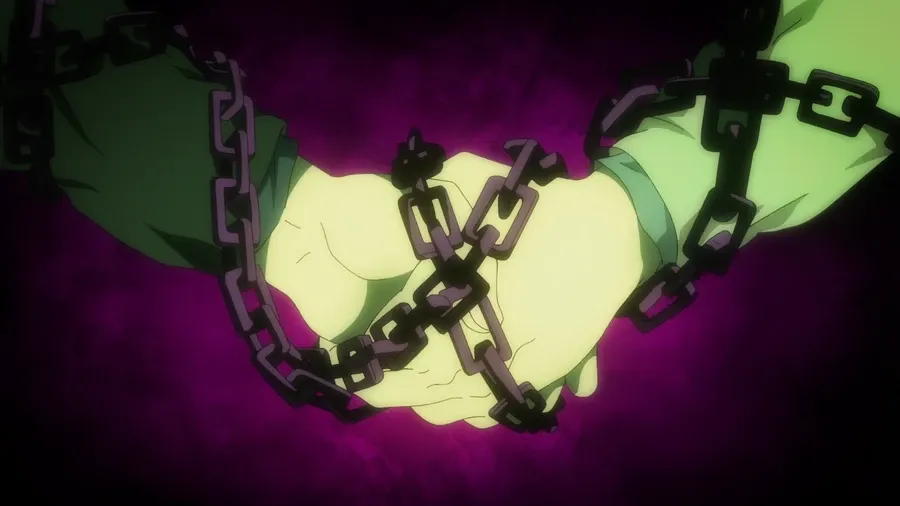
Pacts made by sorcerers and given to them at birth. These pacts hold great power and even greater consequences on breaking them.
Personal Vows
Binding Vows made for yourself and your character will be an agreement between you and your GM, you deciding what you are willing to give and the GM deciding what to give you. You can only have as many binding vows as your proficiency bonus as a rule of thumb but feel free to ignore this.
Solo Binding Vow Examples
Overtime
At the cost of holding back while on the clock, when going overtime you get things done. At the cost of limiting your cursed energy during parts of the day, you can gain a bonus to your cursed energy during other parts. Your CE maximum is reduced by your CE modifier and your technique’s damage die decreases one tier from 9 AM to 5 PM.
Once this time ends, you go into Overtime. You gain temporary CE equal to twice your CE modifier and your technique’s damage die increases by two tiers. These benefits last for a number of hours equal to your proficiency bonus. Once you make this binding vow, you cannot change it until 1 workweek has passed.
Revealing One’s Hand
If you reveal your cursed technique to a creature that can understand you, you gain a +3 bonus to attack and damage rolls made using your revealed technique, as well as a bonus given by the GM that depends on their technique. This ends once combat has ended and you cannot reveal your technique to the same creature more than once or a creature that already knows your technique.
Mind Over Matter
For every limb you give up the use of, you gain a +5 bonus to your CE maximum (no prosthetics).
Immediate Activation
You need to use your cursed technique immediately, but can’t meet the usual activation requirements so you make a vow to use it without them. You create a vow to immediately use a technique that you know as either a reaction or free action just for using said technique for this vow, all other requirements besides cursed energy cost are ignored.
However, you permanently increase the action cost of the technique by 1(free action-> bonus action-> action-> full turn action) and add an additional requirement or prerequisite to use the technique for all subsequent uses of that technique (an example of an additional requirement or prerequisite would be now needing Chanting to use the technique). The increased action cost or additional requirement/prerequisite from this vow will be permanent as the technique has been permanently altered.
Favorite Enemy
You train for 1 hour preparing yourself to fight against a creature you know. You create a vow where you choose 1 creature as your “favorite enemy”, after that you will choose one of the following benefits for your cursed techniques:
- You have advantage on attack rolls against that target.
- You reduce the target’s saving throws against your techniques by your proficiency bonus.
However, any other creature besides your “favorite enemy” adds their proficiency bonus on saving throws against your cursed techniques(even if they already do), and your attack rolls will be at disadvantage against them.
Even if you take this vow multiple times you cannot choose the same creature multiple times.
Multi Binding Vow Example
Master and Servant
Requires 2+ Sorcerers
You have a deep admiration and respect for someone, so much so that you can restrain yourself just to obey them. One of the members of the vow will be the “master” of the vow, while another will be the “servant”. The servant will receive one of the following restrictions:
- Their Cursed Energy’ maximum will be reduced by a number decided by its master.
- Their technique’s range is reduced by a number of ft. that the master decides.(Cannot go lower than 5ft)
- Their technique’s damage is reduced by how many damage dice the master decides.(Cannot go lower than one dice)
- They cannot use simple domains or barriers.
The servant will have this restraint until the master allows the servant to unleash its cursed energy as an action. The servant gains one of the following benefits depending on his restraint.
- Their cursed energy maximum doubles(using the original value without the reduction), and they regain cursed energy equal to the cursed energy they lost.
- Their technique’s range doubles(using the original value without the reduction).
- Their technique’s damage dice doubles(using the original value without the reduction).
This lasts a number of rounds equal to the master’s proficiency bonus, after which this vow can only be used again after a long rest.
Taming
Requires a Sorcerer and Cursed Spirit
You can attempt to tame a cursed spirit, forcing it to obey you by means of a vow.
The cursed spirit’s CR must be equal to or lower than your proficiency bonus. You must spend 8 hours per CR to tame the cursed spirit, in 8 hour periods. During each period, you must make an Animal Handling check DC 10 + twice the CR. On a failure, you must repeat the 8 hr period.
Once you finish the process, the cursed spirit can be commanded as a bonus action. If you attack or harm the cursed spirit, the vow is broken.
Making Your Own
Binding vows can be very powerful, especially if a player bends the rules while creating one. To help maintain balance, here is a list of binding vow concepts to watch out for:
1. Togglable Binding Vows
A player might suggest a binding vow that can be activated or deactivated at will. For example: “I am a limitless user, and I want my blue save DC to be increased by my CE modifier, but it can only affect one creature at a time. However, I can turn this vow on and off, so I don’t suffer any drawbacks.”
This undermines the entire concept of binding vows because the player isn’t truly sacrificing anything if they can simply toggle the effects off. For this, you can enforce a rule that it cannot be changed until completing a long rest once the vow has been made.
2. Not Actually Giving Up Anything
A player might suggest a binding vow where their melee-focused character gains advantage on all melee attack rolls but takes disadvantage on every cursed energy attack roll. Since the character isn’t reliant on CE attacks, this is not a genuine trade-off and doesn’t qualify as a fair vow.
3. More Cursed Energy Cost
A player might suggest a binding vow where they increase their cursed energy save DC in exchange for a higher cursed energy cost. While this might seem reasonable at first, it can quickly become unbalanced. Depending on the boosted feature, it could lead to encounter-ending abilities with impossibly high save DCs.
4. Reaction Negation
A player might suggest a binding vow where they lose something in return for making their cursed energy feature immune to reactions. This should be an automatic rejection, as reactions are a core mechanic of the supplement, and removing them entirely disrupts the balance of play, and completely bypasses most of the defense mechanics in the supplement.
5. Mimicry
A player might suggest a binding vow that allows their technique to mimic a feature from another technique. This should also be outright denied because it often doesn’t make logical sense and can quickly become overpowered.
6. Death Saving
A player might suggest a binding vow just as their character is about to die. For example: “I lose all my cursed energy and fall unconscious, but my technique automatically activates, teleporting me miles away.” This is extremely unbalanced and effectively acts as a “get out of jail free” card, with no meaningful consequences for the player.
7. Rule Breaking
A player might suggest a binding vow that completely ignores the rules of their technique. For example: Idles transfiguration transfigured creatures being primitive or limitless being only able to teleport once per turn. The techniques rules are there for a reason and would stay better if they weren’t broken by a binding vow. However sometimes a vow that breaks your techniques rules can be made good if the downside heavily outweighs the benefits.
8. Refinement Increasing
A player might suggest a binding vow that increases their domain refinement. Under no circumstances should a vow like this ever be allowed. Not only is it incredibly overpowered but it doesn’t make sense lore wise, as binding vows can only be used to amplify a sorcerer’s physicals, their cursed technique, or cursed energy in some sort of way, and the refinement of a barrier is based only on your expertise in putting one together.
9. Metagaming
A player might suggest a binding vow that their character couldn’t possibly know about. For example: A character that doesn’t have a barrier feat or levels in the Support Specialist class, making a binding vow for a complex binding vow for a barrier. For example: I vow that my barrier is reverse triangle shaped and any objects with cursed energy imbued into them can’t pass through it at a certain time of the day but the HP of the barrier is reduced by 30 every round and it’s cursed energy cost is increased by half of the original cost, despite not having any advanced barrier knowledge.
Consequences of Breaking a Binding Vow
A consequence feared by all from the weakest to the strongest. All sorcerers follow one rule; “Do not break a binding vow.”
After breaking a multi binding vow, you lose any benefits from the vow, and either gain 5 levels of exhaustion for 10 days or a major misfortune falls upon you, rolling on the table below.
| Roll | Misfortune |
|---|---|
| 1 | Death. |
| 2 | You lose a limb. |
| 3 | You lose a sense(D4: 1.Touch, 2. Taste, 3. Smell, 4. Sight) |
| 4 | Your stats are reduced by 2. |
| 5 | You cannot use Cursed Energy for 8d4 days. |
| 6 | Your Innate Technique is confiscated for 6d4 days. |
The punishments can be avoided if both parties agree to end the vow.